Please note the dual title. I could not decide on one I liked more, and they're both appropriate. I think I may end up doing this relatively often, considering I've started lumping places together in entries.
It’s time to talk about craic. From Wikipedia: “Crack or craic is fun, enjoyment, abandonment, or lighthearted mischief; often in the context of drinking or music.” However, I hesitate to use it frequently because it seemed to
me like something that was a bit forced for the benefit of making tourists feel like they were getting the authentic Irish experience. Looking at the Wiki article, I may not have been entirely incorrect in that assumption: http://en.wikipedia.org/wiki/Crack_(craic)
However, this entry will mostly concern stuff that falls under that definition, so I figure it’s an appropriate enough opener!
In Killarney, I didn’t make social connections with anybody until my last night there. Sure, I chatted with the New Zealander I roomed with the first two nights (he was impressed that I recognized his accent as NZ rather than Australian), but not much beyond the introductory chat. On my last night in Killarney, though, I met Sean, a bespectacled Tennessean with similar interests to my own. Much to my surprise, I ended up in a very long conversation about something I hadn't expected to think about at all while abroad: video games. Even more surprising was when the nearby girl surfing on her iPod Touch introduced herself as Abi and turned out to have just as much knowledge on the subject! The three of us (along with occasional inclusion of a Canadian fellow nearby) talked into the night ‘til we parted ways to sleep.
Interestingly enough, Abi was supposed to be at my hostel in Dingle at the same time I was there (but changed her plans), AND we somehow ended up as bunkmates in the Doolin hostel. Wacky!
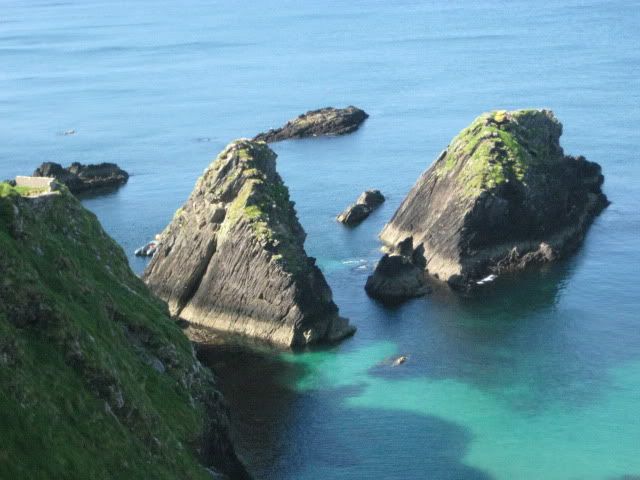
View from the road along Slea Head.
Now, the
Upon arriving in Dingle (the city, not the peninsula), I immediately decided that The Hideout was the best hostel I’d been to yet. It really seemed more like a B&B with a bit more autonomy and less privacy for the tenants – there was actual carpeting everywhere, the kitchen was a proper non-industrial variety, only four beds per “dorm” room, and free continental breakfast! The first night, I went to dinner at An Canteen, a restaurant right next door to the hostel which had opened just that day. Aside from being delicious as well as the least expensive restaurant I saw in Dingle, I was invited to join two traveling American girls, both named Jackie, for dinner. It’s interesting how people come together; they didn’t know each other until they met on the bus to Dingle, and they ended up having dinner and pub-crawling together while they were both in town.
Afterward, one of the hostel employees (maybe even the owner?) by the name of Tom had a “storytelling” session for the tenants, wherein he told a number of old Irish anecdotes and told some poetry. Most notably, he recited the entire conclusion of The Islandman, a memoir that I will go into more detail about later. That was very dramatic, bittersweet stuff. One girl staying at the hostel played “Hallelujah” on guitar and sang it very well, then I was encouraged to play something on my uke. I…have a terrible performance anxiety, and I was only able to play a single disjointed verse before giving up, flustered. Then we all adjourned to the local pub, where Tom continued telling stories. Halfway through a pint of Murphy’s and a Jameson on the rocks, I decided I had
enough confidence to play another song! I chose “Postcards from
Oh, and I later found out that Tom was originally from Chicago and has been kicking around Ireland for fifteen years or so – long enough that he sounds mostly Irish.
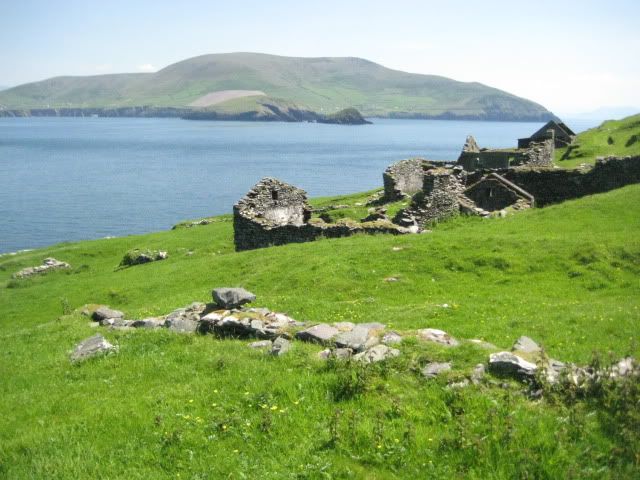
Some Blasket ruins with Ireland in the background.
The next day I went to
basically doing subsistence living, growing/raising their own food, and speaking the least-English-tainted Irish language in the country. In the early twentieth century, scholars of Gaelic from prominent universities all over the
handful of memoirs were produced, the first (and supposedly most poetic) of which being the aforementioned An tOileánach (The Islandman) by Tomás Ó Criomhthain. I am totally going to read that one and perhaps a few
others when I get back. In any case, it’s good the memoirs were produced, because the last remaining islanders
were evacuated to mainland

Great Blasket as viewed from Ireland. The village is just visible - the white buildings are "restored" buildings, and the ruins are down and to the left.
Visiting the Blaskets was my main reason for wanting to stay in Dingle. However, upon visiting the Dingle Marina right after hostel check-in, I was very displeased to learn that the ferry from Dingle to Great Blasket wouldn’t be running again for another five days. And of course there is no bus to Dunquin, the only other city that runs ferries to the island. I was lamenting this turn of events to Tom when an English fellow walked by and said “Well, I’ve got a car, and I’m driving to Dunquin tomorrow. Want to come along?” Problem solved! His name was Dave, from
relatively early and drove out to Dunquin (a beautiful half-hour drive along Slea Head, lots of great coastline with cliffs and such) only to discover that fate was still conspiring against us – the skipper for the ferry that actually stopped on the island had broken his finger that morning! But, said the lady taking bookings, they might be able to find a new captain. “Come back in an hour and I’ll have an answer!” she said. We checked out the nearby
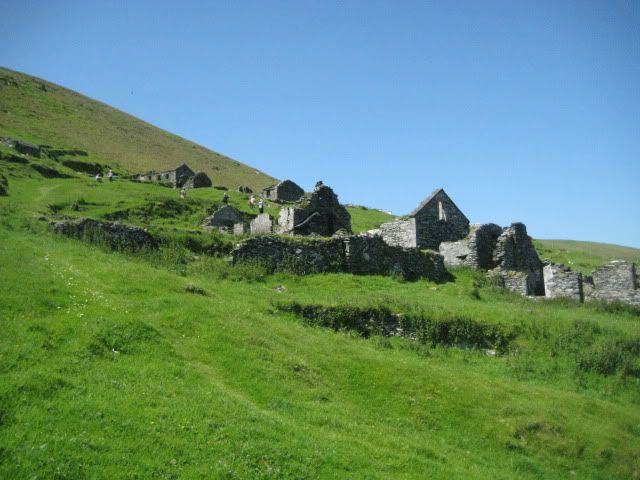
More Blasket ruins.
Great Blasket is an interesting place. When you land, you come up a hill right in the middle of the “village” area, which is now reduced to roof-less ruins (and sometimes broken down to the foundations). You can walk in, on, and around all these abandoned homes, all of which are almost unimaginably tiny. If you follow the coast in one direction, you come to White Strand, the nice beach of the island. If you follow it in the other direction, you’re faced with a sheer rock wall down to the ocean and are directed up a hill towards the center of the island. There
are actually two “peaks” to the island: one is slightly less-elevated than the other and has a small ruined fort at the summit, the other is separated by a bit of a valley and overlooks the whole island. Dave made it to a small plateau halfway up the first, shorter hill before turning back (he had to check out early that afternoon); I continued to the top of the smaller hill and decided I’d accomplished all that I needed to. I circled around the slopes along the coast until I got back to the village, then proceeded to the beach to relax for a bit before getting back on the ferry. I saw a seal pop his head out of the water a couple times! Glee!
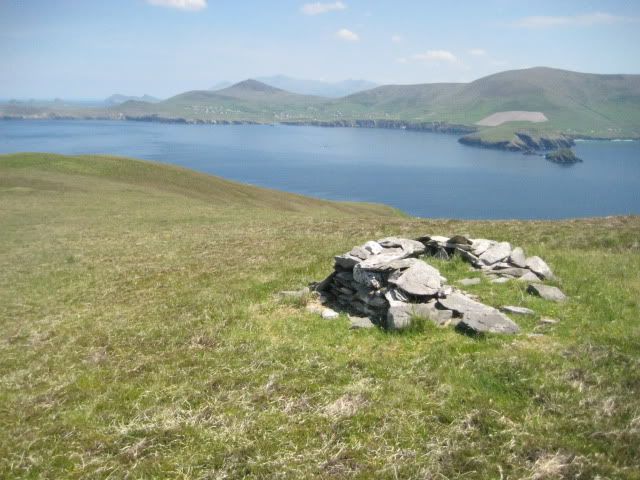
Solitude and a somewhat important-looking arrangement of stones halfway up the second-highest peak of Great Blasket.
By the way, the solitude on the peak was unbelievable. Where I was at, the village and beach were no longer visible (meaning nor were the tourists or the ferries), and I was at a high enough elevation that I couldn't even hear the waves pounding on the island's rocky shore. All there was at the top of that hill was me, a ruined fort, some singing birds, and the wind.
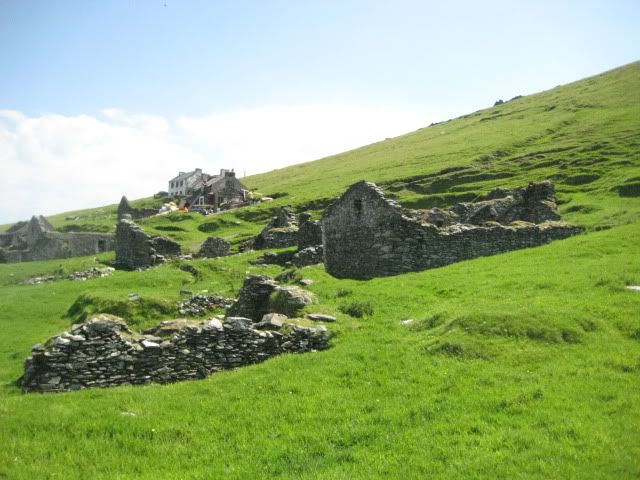
More Blasket ruins, and some dudes restoring a building.
Since Dave had gone home earlier, I had to figure out an alternative method of getting back to Dingle. I was loath to call a cab, and as I mentioned there is no bus at all, so I did what any respectable backpacker would do: I hitchhiked. As I was leaving the ferry-booking area (which, by the way, was not in a harbor but on a cliff on the coast, and you had to go down a long zig-zagging ramp to reach the water) I heard four American-sounding girls and made the logical assumption that Dingle is the nearest tourist-attracting town. I asked if they were heading in that direction and if they could give me a ride. They all hesitated and looked at each other for unspoken decision-making, then said “Sure, why not?” I thanked them profusely and we were on our way. Later in the conversation I learned that they figured there were four of them (all carrying mace!) and one of me, so I wouldn’t be any danger to them. I actually didn’t get their whole story, but they were from all over the States – DC,
That evening I met my new roommate, a middle-aged Irish guy named Jerry. He’s in the middle of cycling entirely around the coast of
Anyway, I’ve already left Dingle, passed through Doolin, spent time on the Aran Islands, and now I'm in London! ...But I'll try to space out my entries a bit so you don't have an enormous wall of text to read. ‘Til then!
P.S.: Here’s a recipe I got from that traditional farm thing for my mom, and anyone else who wants it!
GRIDDLE BREAD:
- 1 CUP SELF-RISING FLOUR
- 1/2 TSP. SALT (optional)
- 1 TSP. BAKING SODA
- 1 CUP SOUR MILK (buttermilk will also suffice)
Mix all ingredients together. Turn out onto lightly floured surface. Knead for approximately 3 minutes. Shape into an 8" round. Using a floured knife, cute round into quarters.
Lightly flour a round griddle (or electric frying pan if no round griddle) and place soda farls on griddle, preheated to 350F. Cook each side approximately 5 minutes. Stand each farl on end for approx. 2 minutes to make sure inside is cooked..
Delicious warm with butter and jam or cut farls in half and in half again and fry in bacon grease until brown and crispy. Serve with fried eggs, bacon, sausages, ham, whatever, and enjoy.


I privately predicted that hitching would eventually find its way into your journey... that seems to be part of the vagabond expirence. And I suppose if you're gonna do it, catching a ride with four girls is a way of bettering the odds.
ReplyDeleteHaving been to Doolin, I know you won't have too much to say about it... but I hope to hear more about the trip to Inisheer. DAD