Well, it’s been a week since I came back to America. Since then, I’ve attended my sister’s graduation party and spent fun times up north with my friend Mark and his family. I have also wholly returned to an “America” mindset. That is to say, once I was in a familiar place again, I was overwhelmed by the feeling that I’d never left at all.
It’s surreal, knowing that I’d spent three months having a once-in-a-lifetime adventure but feeling like it was something that happened to someone else. Does anyone else who’s studied abroad or whatever felt like this? I can remember everything that happened, and I remember enjoying all (well, most) of it, but now that I’m in my home I feel somehow detached from the whole thing. Perhaps, with time, it’ll solidify in my mind like a normal memory.
Even still, I know that this was a good thing for me to do. My dad has told me repeatedly that he has co-workers who did something similar when they were my age, and they still talk about it fondly. Also, I presume that as time goes on, I’ll slowly idealize the whole thing by forgetting the bad parts and embellishing the good parts. Not to mention that I learned things about myself: how I function without a support system, what kind of social situation I want/need to be in, etc.
I dunno, I feel like I’m not wrapping this up in a particularly interesting way. I guess there’s not much to be said. I was happy to come home, but I don’t regret a bit of what I did while I was away. I got to see the places my family came from. I saw fantastic things that I had hardly dared dream of seeing in person. I’ve met friends that I made from across the world and made new ones that I’ll need to visit sometime in the future. I spent over $3700 in three months. I grew a pretty rockin’ beard. Thanks, everyone, for reading along with my adventure. I hope it was enjoyable, educational, entertaining, you know the drill.
As a final delight, enjoy this list of the pun-filled blog titles that I wasn’t able to fit in for one reason or another. Thanks to everyone who suggested some of ‘em!
Eire in the world is Patrick Sandiego?
Chaos Emerald Isle
Pat O'Cakes.
Hardcastle McBlog
Patty’s Fabulous Farmcation
Taoiseach Baby Syndrome
Sinn Fein-ing Interest
Celtic'd Off
Oh my God: Kilkenny
Tipperarily Irish
Harping on Ireland Patrick's Belfastic Adventure
Are you a leprechaun or a lepre-can't?
The Emerald Easel
Oh gosh – I forgot to mention, on Day Two. Easily the coolest part of the Museum of Archaeology was an exhibition they had on bog bodies! For those who aren’t in the know, bog bodies are human corpses that are occasionally unearthed in peat bogs while turf is being harvested. Due to the oxygen-free environment and some chemicals in the bogs’ soil, the bodies are remarkably preserved (if slightly crushed) with a distinctive tar-black skin color. Almost every body found in this way was killed violently: hanging, decapitation, bludgeoning, you name it. However, some of them have a very eerie calmness about them, as if they’d simply been sleeping in the bog all this time.
Day Three.
I’d been told to check out Kilmainham Gaol (pronounced “jail”, because that’s what it is). It was a bit of a hike outside of the city center, so I got started immediately after breakfast. I walked, and walked, and walked some more. I reached the train station that, according to my map, was right before the gaol. Perfect! …Then the sidewalk disappeared, and I was walking through the station’s carpark. Okay then. And after about ten minutes walking, passing by some very behind-the-scenes-looking stuff, I reached the fence that, apparently surrounded the entire station. Well, great! I backtracked to the entrance of the station and instead took the road that looked like it curved around it. Another twenty minutes walking – no such luck. The map had me totally befuddled, and I couldn’t find a street with a damn sign on it. (This is a common problem in Ireland; they seem to find displaying street names a form of weakness.) I gave up and backtracked to the hostel for lunch.
Actually, on the way back I stopped at the Winding Stair café, which is a place Rebecca had recommended to me. It’s a combination independent bookstore and restaurant, and after checking out the (pretty nice) book selection I headed upstairs to the restaurant. Then I came right back out. €18 for LUNCH?! No thank you, no matter how highly recommended it was! Later, I wandered around Temple Bar, which is the hip and happening part of town, apparently. It seemed cool enough – lots of new-age and hippie and indie kind of stores – but I think it pales in comparison to Ann Arbor or Ferndale!
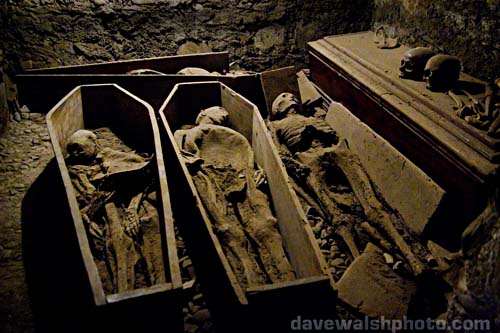
Then I went to St. Michan’s Cathedral. Despite having a thumbs up logo in my guide book, it was a small, unassuming, and mostly-empty church. I had a peek inside the church itself – nice, but mostly unremarkable. The main draw for St. Michan’s is its extensive collection of underground funereal vaults. OoooOOOooo! The church building has apparently been rebuilt within the last three hundred years, but the vaults are “original” – now, I’m told by the internet that the church was built on an 11th-century Viking church foundation, but I don’t think they’re THAT old. Three strangers and myself – the only people waiting for the tour at the time – were taken down a dark, steep, stone stairway. Our crypt guide was a sardonic chain-smoking Irish guy who clearly relished his satirically over-dramatic presentation. He also knew a lot about…well, everything. He knew details of the area that the English tourists were from, and he knew a surprising amount about Michigan, even including Ann Arbor as a guess as to what city I might have come from.
Some mummies! Not my photo.
Anyway, the crypts were pretty neat. None of the bodies there were preserved intentionally – it all happened naturally, due to the dry, cool, and slightly methane-laced environment in the underground vaults. And the preservation is quite impressive! Not as perfect as the bog bodies, and a lot more dusty and mummy-looking (though that may be simply because they’ve been largely untouched, while the bog bodies were carefully excavated and cleaned). One of the bodies, traditionally known as The Crusader, is actually in the neighborhood of 800 years old, meaning that he died several years before the crusades even started. Also, they actually let you shake hands with him. His touch is supposed to bring you good luck. Awesome. There’s also a crypt with the lavishly-decorated coffins of the Lords of Leitrim, who stopped using their family crypt after interring (in a very plain coffin) the most-hated member of the family. Speaking of which, apparently 90% of the crypts are still officially “active”, meaning that people sharing the surname associated with them could legally return to bury their family members there. There’s only one family that still does this. However, due to their legally “active” nature, the crypts cannot be disturbed. This means that the only ones that were lit up and open for us to observe were the inactive ones and the anonymous ones whose coffins had broken open on their own (like The Crusader and his roommates). It’s also the burial place of two brothers, Henry and John Shears, involved with the 1798 rebellion.
The Crusader! Not my photo.
(I totally shook hands with The Crusader.)
For dinner, I looked at the options I had in my meager groceries at the hostel, then said “fuck it, I only have two nights left” and bought myself a kebab. In Ireland and the UK, a kebab means something different than it usually means in the States: it is an enormous pita pocket that is filled with something close to gyro meat (known as doner, as in “I’ll have a doner kebab”, and shaved off a big rotating meat cylinder as gyros are) or similarly-cooked chicken, then topped with lettuce, parsley, onion, pickled cabbage, tzatsiki sauce, chili sauce, and pepporocinis if you want them. The final product is a little larger than your average calzone. Mmmmm.
Day Four.
I finally got tired of walking – due largely to yesterday’s ultimately aimless wandering session – so I gave in and got a ticket to one of the hop-on-hop-off bus tours that circle the city. The idea here is that these double-decker buses make constant loops of the city, one arriving at each stop every ten minutes or so, and all with some sort of audio guide (be it live or pre-recorded). The bus tour had been recommended by many people, including my parents and the Hillmans, but I couldn’t bring myself to spend the extra money. I had a map of the city, a list of things to do, and a willingness to walk around. That was all I needed, right? Wrong, apparently, considering my expedition the previous day. Thus, I somewhat reluctantly ponied up the €13 and hopped on a live-tour bus.
The tour itself was pretty good. Our driver’s commentary had the friendly but emotionally-deadened manner that seems to accompany spiels that are repeated so often that they lose all meaning. There was excitement at one point when a van stalled in front of the bus, causing us to rear-end them lightly. Though all of us tourists looking down from the second deck agreed that we couldn’t see any damage, there was a fifteen-minute insurance exchange. I hopped off at the Kilmainham Gaol that I had been trying so desperately to reach.
Now, the gaol operated from 1796 to 1924, when it was closed by the newly-formed Irish Free State. It its time open, it experienced quite a lot of history. During the Famine, there were three thousand people crammed into 112 cells, due to the prevalence of the crimes of begging and stealing food. It was the place where fourteen of the leaders of the Easter Rising were imprisoned and, ultimately, executed by firing squad. At the time of the Easter Rising, these rebels were generally disliked by the Irish public, but due to their execution – seen as an extreme overreaction on the part of the British – the rebels became martyrs, strongly turning the public opinion in their favor. The only Easter Rising mastermind not to be executed was Eamon de Valera, because he was found to be an American citizen. Later, de Valera became the last person incarcerated in the gaol and, ultimately, president and prime minister of the Republic of Ireland. The gaol was closed for several years, and in the 1960s was renovated as a national treasure. Much of the renovation was done by former political prisoners, actually. Today, it’s a good tourist destination, and across the street is a slightly-abstract but powerful memorial to the fourteen executed Easter Rising leaders.
The most interesting part about my experience was that I accidentally slipped into a private tour that was starting at the same time as one of the public ones. Said private tour was composed, appropriately enough, of Irish ex-prisoners. This resulted in a very interesting presentation, wherein a scholarly-looking guy gave a powerpoint discussing the history of the gaol and a room full of friendly but decidedly “dodgy” characters laughed and shouted out comments and questions the entire time. At this point, of course, I wasn’t yet aware that I was on a prisoner’s tour, so I simply thought it was a boisterous crowd, and I silently commended the tour guide for his patience. Also, the ex-cons were surprisingly knowledgeable about the Irish history associated with the gaol, particularly that related to the Troubles. About halfway through, we figured out what had happened, and I got into a regular tour. Ho hum!
How delightfully Irish!
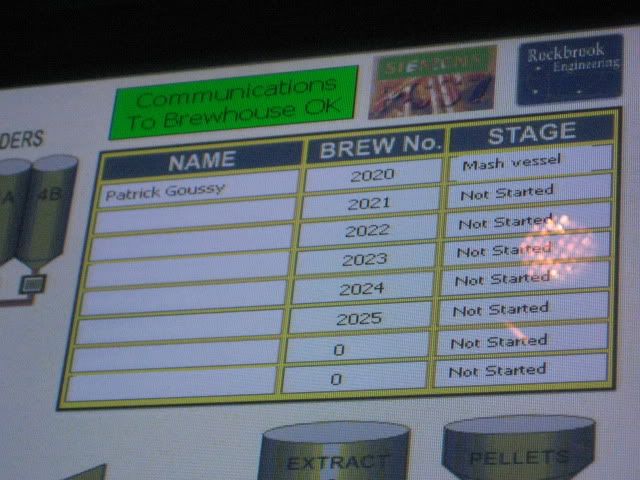
Next, the Guinness Storehouse. I’d been told by several people to “skip Guinness and do Jameson,” but I felt like I couldn’t say I’d toured Dublin until I’d done the Guinness thing. Now, I’m not much of a beer drinker. Guinness and other stouts rank among my “pretty okay” beers, but I’m not a huge fan. That being said, the Guinness Storehouse is an extremely well-made attraction. It’s a seven-story roughly-cylindrical building centered around “the largest pint glass in the world”. You pay your money at the entrance, then take yourself on a self-guided tour, so it really is what you make of it. There are areas devoted to ingredients, brewing process, transportation, coopering (making barrels), advertising, company history, responsible drinking, and probably a few more that I’m forgetting. Notably, I was selected to press a button that started the brewing process on a new batch of Guinness (batch #2020, if there’s some way to look that up).
I'm...so proud.
The advertising stuff was far-and-away my favorite portion. There was one section devoted to the company’s entire ad history, including videos, posters, relics such as lamps and ashtrays, etc. In addition to that, there was a separate exhibit celebrating Gilroy, the illustrator who made Guinness advertisements some of the most famous in the world: “My Goodness, My Guinness!”, “Guinness Is Good For You!”, “Guinness For Strength!”, “Lovely Day For A Guinness!”, along with the famous toucan, ostrich, sea lion, zookeeper, construction worker, and plenty more. He was quite an ad man, I tell you this much.
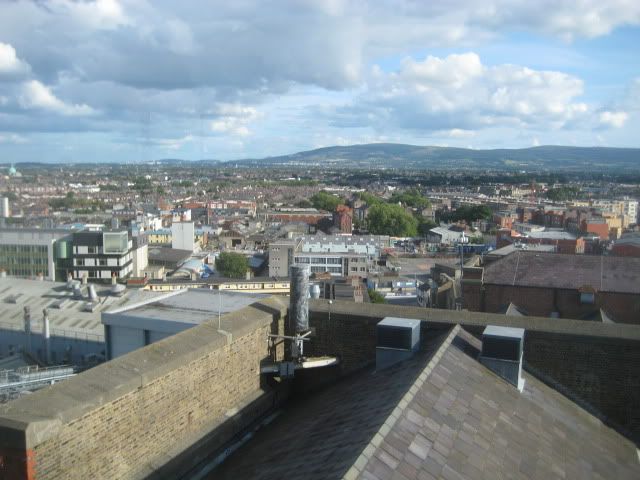
Nice view, huh?
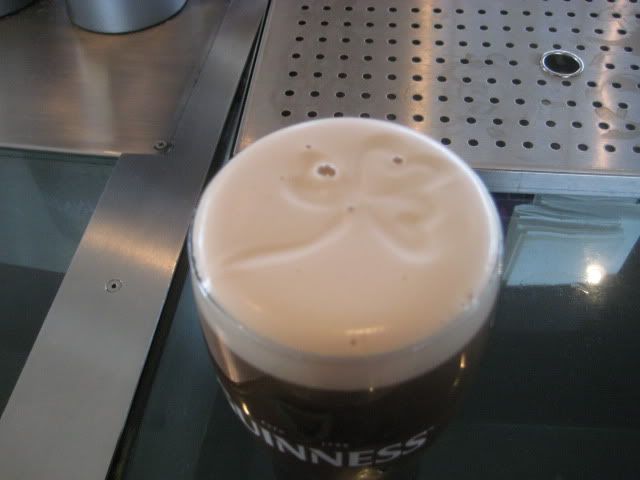
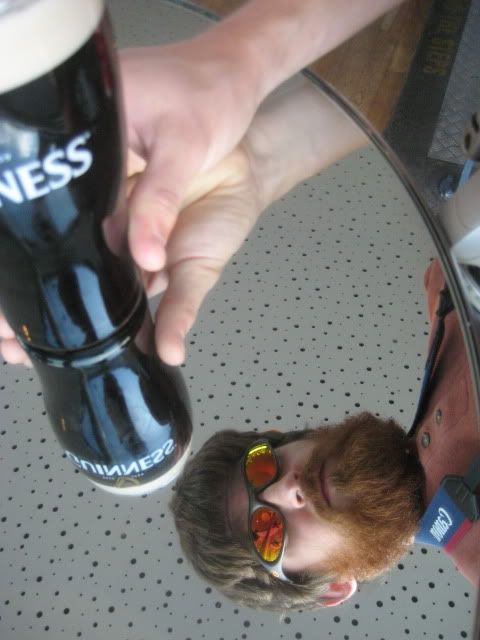
At the very top is the Gravity Bar, where you get a complimentary pint of Guinness (complete with a shamrock drawn in the head) and an absolutely unbelievable 7-story-high 360-degree view of the city. My verdict: totally worth doing. If nothing else, you can marvel at the incredible image (and subsequent devoted following) that Guinness has built up for itself, around the world and in Ireland specifically. As I said, I’m not much of a beer drinker, and therefore not much of a Guinness drinker, but I found the entire experience entertaining and engrossing. Guinness: It’s Alive Inside!™
My last photo in Ireland!
For dinner, I found myself a well-reputed gastropub and bought myself a huge bowl of Guinness and Irish beef stew and roasted potatoes – my first and only “Irish stew” of the trip. Good way to end, food-wise.
Then I had a long, boring, delayed (read: typical) day of travel. And now I’m home! HUZZAH!